What is the dark funnel?
The "dark funnel" is the set of buying signals and influence that shape a deal, but don’t show up cleanly in your attribution reports.
Subscribe to my newsletter to see content first:
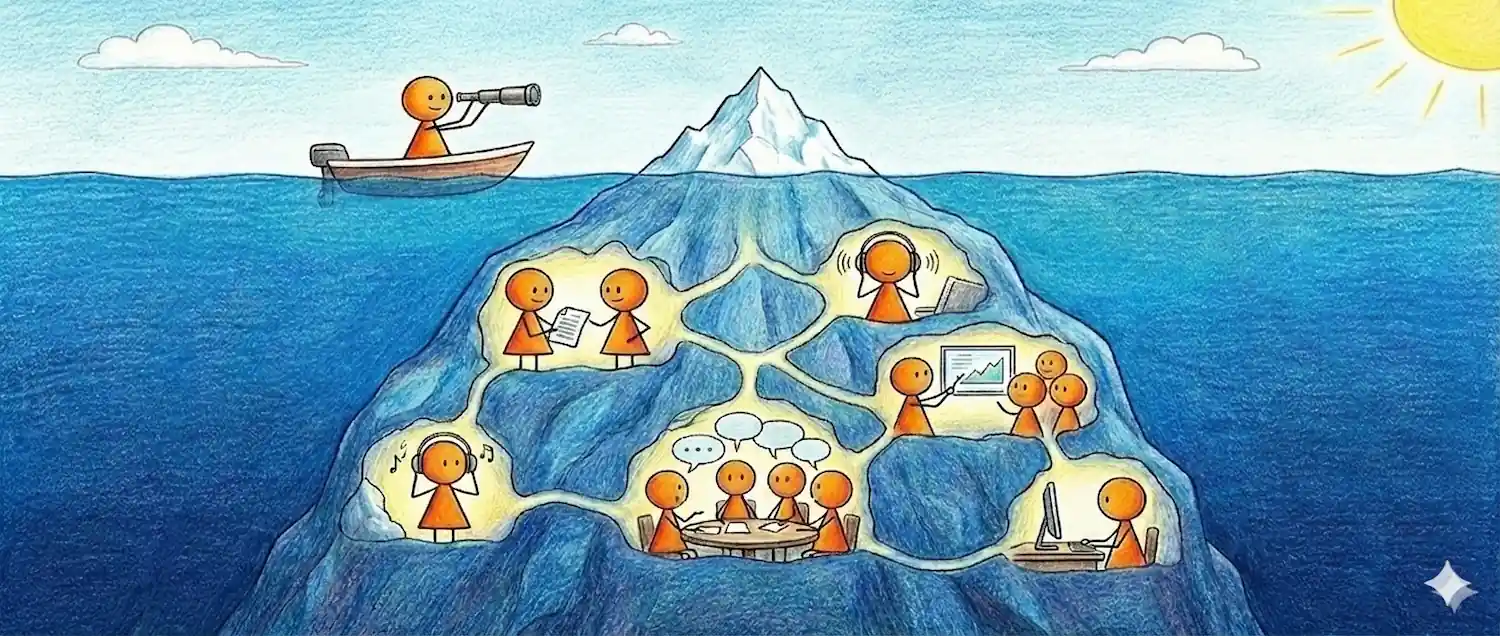
The “dark funnel” is the set of buying signals and influence that shape a deal, but don’t show up cleanly in your attribution reports.
It’s “dark” not because it’s shady, but because your dashboards can’t see it.
If you run B2B growth, you’ve seen the symptom: pipeline appears to come “out of nowhere”. Or worse, it’s credited to the last touch (usually a brand search, a direct visit, or a single form fill) while the real story happened elsewhere.
What sits inside the dark funnel
Think of it as everything that meaningfully moves a buyer forward before they become trackable.
Common examples:
-
Private conversations
Slack groups, WhatsApp threads, DMs, internal email chains, “hey, has anyone used X?” in a leadership channel. -
Off-platform consumption
Podcasts, YouTube, webinars watched in full-screen mode, screenshots of your pricing page passed around internally, PDFs forwarded. -
Consensus-building inside the account
The champion explaining you to procurement, finance, IT security. The internal deck they make about vendors. The meeting where you’re compared against two alternatives. -
Peer validation
”I asked three other RevOps leaders.” “My mate at a Series B says these guys are solid.” None of that is in Google Analytics. -
AI-assisted research
People summarising your docs with AI, asking for comparisons, generating internal notes. The influence is real; the referrer often isn’t. -
Silent intent
Multiple people from the same company repeatedly visiting, but cookie consent, device switching, ad blockers, and privacy settings mean you can’t stitch it together with confidence.
Why it matters
Because most B2B decisions are not linear and not single-threaded.
Buyers don’t go:
Ad → Landing page → Form → Demo → Closed won
They go:
Heard of you somewhere → forgot → saw you again → asked a peer → lurked → checked you on LinkedIn → screenshot pricing → internal debate → then someone finally fills a form.
If you only measure what’s attributable, you end up optimising for the last measurable step, not the steps that actually create conviction.
That’s how teams accidentally:
-
over-credit retargeting,
-
underinvest in content and community,
-
misread “direct” traffic as “brand strength”,
-
and wonder why CPL goes down while win rate and ACV stall.
How to work with dark funnel (without pretending you can fully “track” it)
You don’t “solve” dark funnel with one clever dashboard. You manage it with a mix of instrumentation, inference, and buyer-reality.
1) Measure what you can at the account level
-
account-level traffic trends (even if user-level is messy)
-
engaged accounts, repeat visits, key page sequences
-
spikes after campaigns, events, or PR moments
2) Add “self-reported attribution” everywhere it matters
-
“How did you hear about us?” with a short, honest dropdown plus a free-text field
-
capture it on demo request, not just on first-touch forms
-
ask in discovery: “What changed that made this a priority now?“
3) Optimise for evidence of conviction, not just clicks
-
increase depth signals: pricing views, integration/docs views, case study consumption
-
build assets that make internal selling easier: 1-pagers, security notes, ROI narratives, comparison pages
4) Treat LinkedIn as a dark-funnel engine
B2B buyers spend months building a point of view before they “convert”.
Your consistent presence (posts, comments, founder POV, customer stories) creates familiarity that later masquerades as “direct”.
5) Accept attribution is a model, not a fact
The moment you treat last-touch as truth, you start making confident decisions on incomplete data. Better to be approximately right with multiple lenses than precisely wrong with one.
The simplest way to explain it
Dark funnel is the part of the buyer journey that changes minds but doesn’t leave neat breadcrumbs.
And the goal isn’t to flood it with tracking hacks. The goal is to build marketing that wins in the real world, where most influence happens in places you’ll never get to tag with a UTM.
About Riaz

I've spent over 20 years building and scaling B2B products, services and marketing technology - from early-stage startups through to exits, and now as CEO of Radiate B2B - the B2B ad platform.
Along the way I've led teams, launched products, built and sold companies, and spoken around the world about data, AI and the future of marketing and work.
Today I split my time between working directly with companies as a consultant and fractional operator, mentoring founders and leaders, and speaking to audiences who need someone to translate what's happening in technology into decisions they can act on.
Read the full storyRecommended posts

Harnessing Intent Data: What It Really Means for B2B Tech Marketing
Intent data isn't a silver bullet. Here's how B2B tech marketers should really use intent signals to prioritise accounts and change behaviour.
Read more
What is intent Data?
B2B (business-to-business) intent data is information about the online behaviour of companies that indicate their interests and purchasing intentions.
Read more
Intent data isn’t magic. It’s a way to stop guessing in outbound.
Intent data isn’t magic—it’s a way to stop guessing in outbound. Learn a practical 5-step playbook to prioritise accounts, align sales and marketing, and create pipeline.
Read more