The three questions every CEO must answer before adopting AI across the business
Most AI conversations happen at the wrong level. Here are the three questions I ask every CEO before a single tool or roadmap gets discussed.
Subscribe to my newsletter to see content first:
When I first talk to a CEO, they already know AI matters. There is fear of falling behind, pressure from the board, and for some real opportunity.
Some have tried something - a tool, an automation, something a team member set up. But most of the time, they fail or it is limited in its benefits to the wider company. It doesn’t actually change the business metrics.
RAND puts enterprise AI project failure at over 80% (RAND Corporation, 2025).
How do we successfully take advantage of AI?
It is a reasonable place to start. But first you need to answer three other questions.
Tools, rollout plans, roadmaps - these are not useless conversations, but they only work once you already know what you are trying to achieve and where AI creates real value in your specific business.
Here are the three questions I start with.
Where does the work actually pile up?
Understanding the processes and effort required to currently deliver output is the first step.
Not “where could AI help” - that question, asked cold, just sends you shopping for tools.
The second step is to then get an understanding of what is possible with AI.
In a professional services business I worked with last year, the answer was their project scoping process - every new engagement involved the same back-and-forth between four people over two weeks, pulling in the same information from different places every time. Everyone knew it was slow and cumbersome. Nobody had fixed it because there was always something more urgent.
Start from the friction. Bring what you already know about what’s out there - don’t lead with it.
What will really move your margins?
Rarely the tool itself. What matters is whether the outcome is financially material, not just useful.
This is the question that separates serious investment from tinkering. It forces economic thinking rather than usefulness thinking.
Most AI adoption gets stuck because the people driving it are optimising for “useful” rather than “material”. A tool that saves each person an hour a week is useful. If your team is eight people and the real constraint is somewhere else entirely, you have not moved the needle.
If this worked exactly as we hoped, what would the financial or operational outcome be in twelve months - and is that outcome worth the time and focus we are about to spend on it?
If you cannot answer that with confidence, you are not ready to invest. You are ready to experiment. Those are not the same thing, and conflating them is how AI projects lose credibility inside a business.
Who in your business already knows what is working?
Someone on your team is using AI in a way that has changed how they work. They may not have mentioned it. They may not have thought it was worth mentioning.
But in every business I have spent time in - without exception - I have found this person. Usually within the first two weeks of working with a new client.
The best signal for where AI creates real value in your specific business is not the vendor case studies. It is not the industry reports. It is the person two levels down who figured something out three months ago and has been quietly doing it ever since. Finding them, understanding what they are doing, and asking whether it scales is also, more often than not, the answer to where you start.
Most AI conversations we are having start from the outside in. A new capability appears, we read about it, and the question becomes: how do we use this?
These three questions start from the inside out - but with AI innovation moving so quickly, the first one only works if you already know enough about what’s out there. Where is work piling up? What would actually move the business if it worked? Who has already found something real?
Every AI decision you make from here is anchored to something specific - your business, your bottlenecks, your people - rather than to what AI can do in general.
If you want to work through these questions with someone who has been inside enough businesses to know what the answers usually look like - that is what the advisory sprint is for. Book a 20-minute call →
FAQ
What’s the first question to ask before starting an AI project? Where the work is actually piling up - not where AI could theoretically help, but the two or three places everyone on the team already knows are broken.
Why do most AI projects fail? RAND puts the enterprise failure rate at over 80%. Most projects skip the diagnostic step and jump straight to tools, rollout plans, and roadmaps before anyone has agreed what the business is actually trying to achieve.
How do I find where AI will actually help my business? Look for the person on your team already using it in a way that’s changed how they work. In every business I’ve spent time in, without exception, that person exists - usually within the first two weeks of working with a new client.
About Riaz
I've spent over 25 years founding and scaling B2B companies - as COO, CEO, CMO and CTO, often across the same company's lifecycle. An engineering degree from UCL and an MBA from Bayes means I understand both the technology and how a business actually runs around it.
I co-founded Digital Oxygen, which was acquired by Silverpop and later by IBM. I scaled Profusion from 15 people to 100. I founded and led Radiate B2B for nine years, building the first MCP-based AI connector for LinkedIn Advertising, before closing it in 2026 rather than rebuild around a declining display-advertising market.
Today I run Connected Paths, an AI implementation consultancy, and work directly with a small number of B2B founders and CEOs through advisory, fractional COO, CMO and CTO work, mentoring and speaking. I've mentored 50+ founders through Techstars, UCL and Bayes, and chaired the Cass Entrepreneurs Network for its 3,000 alumni and investors.
Read the full storyRecommended posts

Does employee monitoring improve behaviour? The research
Ellison says more cameras mean better behaviour. Workplace-monitoring research says visibility helps in narrow, bounded cases - and erodes trust and performance when used to control people over time.
Read more
SaaS Is Not Dead. But AI Is Changing What Good SaaS Looks Like
SaaS is not dead, but AI is changing what good SaaS looks like. The future is open, modular, AI-connected software that adapts around the workflow.
Read more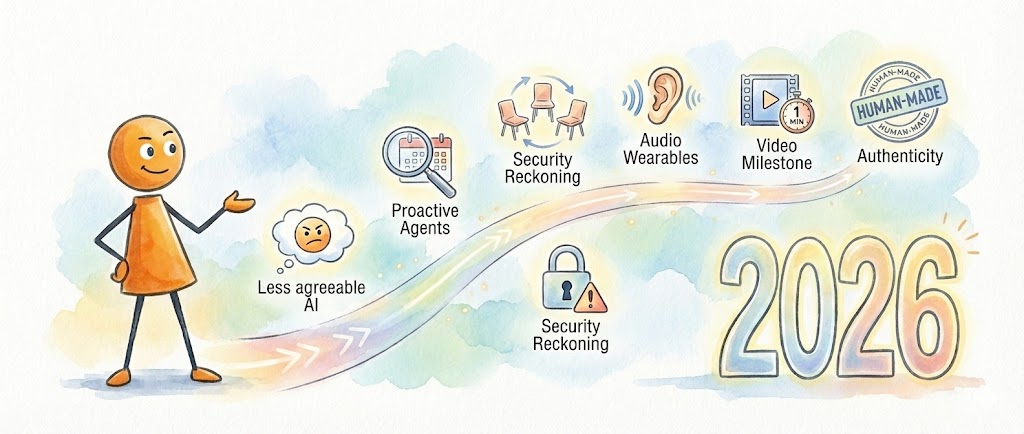
AI in 2026: Another fast moving transition year
What's next for AI in 2026? Dive into my predictions on agentic AI, the battle for audio wearables, the 1-minute video milestone, and the authenticity race.
Read more