AI in 2026: Another fast moving transition year
What's next for AI in 2026? Dive into my predictions on agentic AI, the battle for audio wearables, the 1-minute video milestone, and the authenticity race.
Subscribe to my newsletter to see content first:
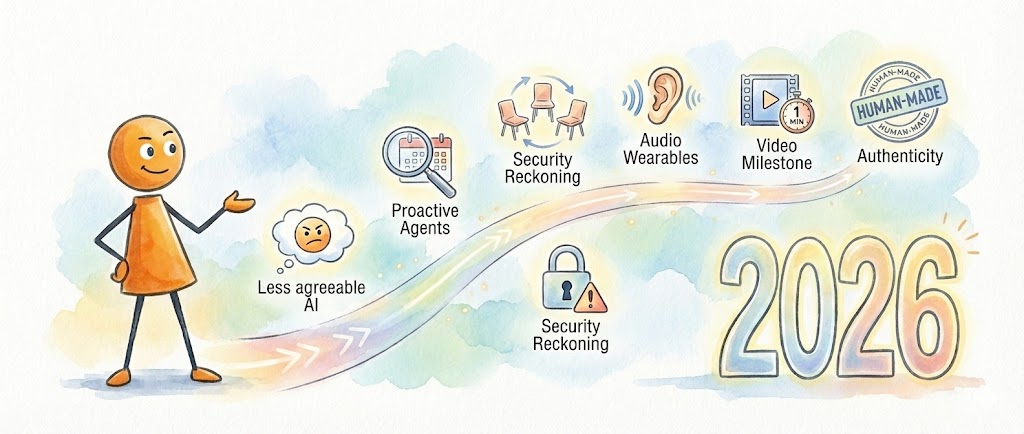
Following on from my 2025 AI review, I thought I’d get back to publishing my thoughts on the upcoming year.
2025 saw more user growth, better adoption, and greater integration in the day to day of the workplace. For early adopters.
In 2026, I don’t think it should surprise anyone, that I expect more user growth. I also expect more platforms from the LLMs that makes it easier to integrate into your day-to-day workload.
Here are my wider thoughts on 2026:
1. Less agreeable!
For the last few years, AI has been a digital parrot. You ask, it answers. Usually agreeing with you.
We now know that is a training problem, and I am hopeful some of the models later in the year are able to solve that issue and be more open when it doesn’t know the answer. That alone will remove some of the workload of double checking AI responses.
2. From Reactive Prompts to Proactive Agents
Agentic AI was everywhere in 2025. But 2026 is going to bring it to the mainstream. Your AI assistant won’t wait for a prompt; it will monitor your platforms — your CRM, your calendar, your meetings — and proactively make suggestions.
We should also see it doing things automatically on your behalf. Manual tasks that you might be manually prompting right now, will just happen and be delivered to you.
3. The Great Security Reckoning
The downside to 2 is going to be security. Proactivity and access to more of our data is going to create big headlines for all the wrong reasons.
Not from a traditional hack, but from an agentic AI sharing data publicly it shouldn’t. This is going to slow down adoption in the enterprise I think, until there are guardrails that can be put in place centrally.
For everyone else, care is going to be needed.
4. LLM Musical Chairs (and the China Factor)
The race for the “best” model swapped back and forth in 2025. I don’t see Gemini consolidating its end of year success. I also think it is going to be less important, with the software that sits around the LLMs becoming more important and more sticky to user retention.
5. Hardware: The Battle for Your Ears
There is a lot of noise about smart glasses (I still want one), but I think audio-only wearables will be the early 2026 winners.
Why? Lower friction. While we’ll see massive debates about the privacy of face recognition and constant recording (which we will eventually overcome with “opt-in” frameworks maybe connected to our social networks), sound-only devices avoid the “creep factor” of a camera.
That could mean the end of the standalone “AI Note Taker.” When your assistant lives behind your ear or on your top, it provides real-time context. I think the former is more likely as it enables you to hold a two-way conversation, the “bot that joins your Zoom” becomes a redundant relic.
6. Video: The “Minute” Milestone
In 2025, we had 10-second clips. In 2026, I am hopeful that we can really push video forward and reach 1 minute clips with an AI able to maintain a character’s face, clothing, and lighting without “hallucinating”.
This is the inflection point where AI video moves from a social media gimmick to a legitimate production tool for B2B brand storytelling.
7. The Authenticity Arms Race
We are already at a tipping point. You should already assume all content is AI-generated until proven otherwise. Content has become a commodity. Because of this, “Human-Made” will become a premium certification — think the “Organic” label for data.
In high-value B2B sales, the most valuable “signal” will be the one that cannot be automated: direct human interaction.
The Bottom Line
We are still transitioning to AI. Adoption is swift, and 2026 is going to be more of the same, but real transformation of companies is going to take much much longer. Think a decade or more.
But 2026 is the year I think we will see how it affects the wider society as we adopt the hardware alongside the phone (at least initially).
About Riaz

I've spent over 20 years building and scaling B2B products, services and marketing technology - from early-stage startups through to exits, and now as CEO of Radiate B2B - the B2B ad platform.
Along the way I've led teams, launched products, built and sold companies, and spoken around the world about data, AI and the future of marketing and work.
Today I split my time between working directly with companies as a consultant and fractional operator, mentoring founders and leaders, and speaking to audiences who need someone to translate what's happening in technology into decisions they can act on.
Read the full storyRecommended posts
2025: the year AI stopped being "a tool" and started becoming the operating system
AI in 2025 went from novelty to infrastructure. Sora reignited adoption, MCP connected data and tools, Gemini surged, and agents made work repeatable.
Read more
The future of innovation, startups and the world. That's all.
I'll reflect on both in the next week or so I suspect but this week's newsletter looks at innovation, the business of looking into the future, how.
Read moreStrawberry picking robots, winning users and societal challenges.
This week returns to strawberry picking robots, overcoming inertia to win users and the challenges of user generated content for children and wider.
Read more