2025: the year AI stopped being "a tool" and started becoming the operating system
AI in 2025 went from novelty to infrastructure. Sora reignited adoption, MCP connected data and tools, Gemini surged, and agents made work repeatable.
Subscribe to my newsletter to see content first:
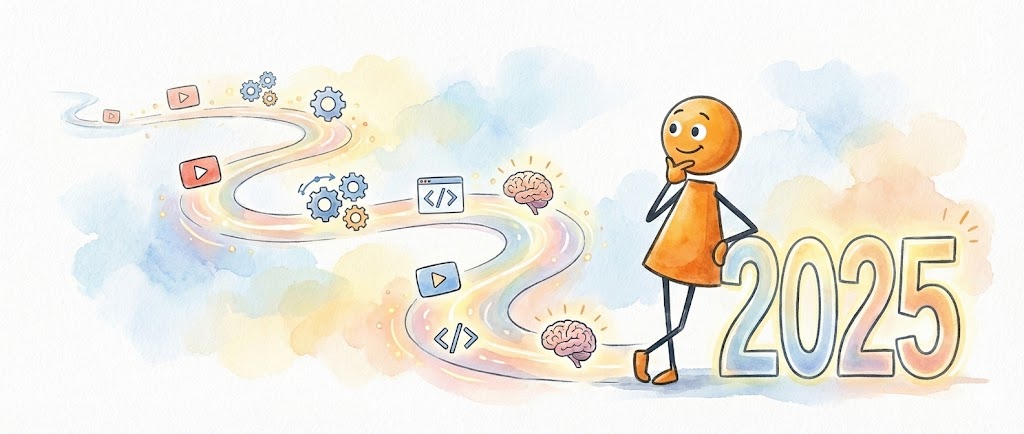
2025 was the year real AI adoption shifted. Previously, most people who tried AI didn’t want to try it again. AI didn’t just get better. It got stickier, more connected, and started to become part of your working week.
These were for me the key moments that set up 2026 and beyond (and my 2026 prediction post!).
1) Sora pulled people back in by riding the viral wave.
The first adoption wave of 2025 was driven by the internet doing what the internet does.
OpenAI shipped Sora 1 in December 2024 (Open AI), and the output hit social feeds hard. You suddenly had Sora images everywhere - remixes, memes, “how is this even real?” moments.
It reactivated a huge group of people who’d already tried AI once and had moved on. Sora made people try ChatGPT again and saw a big uplift in quality.
The same cannot be said later in the year when OpenAI launched Sora 2 in September 2025 (OpenAI). This time they created a newsfeed style app with remixing and characters. It was a leap forward (since outdone by NanoBanana from Google) but putting it inside the app seemed to limit its usage.
By January 2026, reporting was already highlighting falling installs and consumer spend after the early hype. (Techcrunch)
On an aside - they built the app entirely using their new Codex platform, which competes with Claude Code and helps to build apps etc. Quite surprising at the time. Shipping Sora for Android with Codex. Read more here.
2) MCP quietly became “the standard connector for agentic AI”
More behind the scenes, but way more important was the adoption of the model context protocol (MCP). This is changing the way things get built. MCP Apps
The point of MCP is simple:
- models need tools
- tools need data
- and without a standard, you end up with a mess of one-off integrations
MCP effectively allows for the app store to exist in ChatGPT, Claude etc.
And this is where I got personally invested.
We built the first LinkedIn Ads MCP Server that lets you talk to your campaigns. Ask questions. Pull performance. Slice it. Summarise changes. Spot what matters.
It saved me a tonne of time and allowed me to do more analysis more frequently thanks to the speed improvement.
3) MCP-UI and ChatGPT Apps: the start of software that assembles itself around you
Connecting to data to AI is only half the job. Being able to visuliase the data and act directly on it makes it usable.
2025 showed us the first steps towards a standardised UI layer.
On the MCP side, Shopify published MCP-UI (August 2025) as a way for agents to return interactive components—not just walls of text.
The best part? Anthropic launched MCP-UI in the summer with OpenAI launching Apps in October. By November we had a standard spec that means you only need to build once MCP Blog.
This is the beginning of:
customised front ends per user
UI assembled on demand
around their tools + data + intent
We’re still early. The UI generation needs to get faster and more reliable.
But even now, for small pieces of visualisation, it changes the power dynamic - especially in retail and ecommerce. Retailers can build connectors that ensures not only the right imagery is used but even how it is presented.
That’s going to matter a lot.
4) Gemini came back (and “Nano Banana” became a real differentiator)
For most of 2025, the online commentary was: “Google missed it.”
By the end of the year, Gemini was everywhere. Plenty of people started switching or running a two-model setup.
I use both. My experience is:
- Gemini can feel stronger in a single long back-and-forth session before it starts dropping context.
- ChatGPT still feels like the cleanest “default” for a lot of workflows.
But the most obvious gap for me ended up being image generation.
Google pushed “Nano Banana” / “Nano Banana Pro” as its image generation models inside Gemini.
And the output quality and speed were consistently impressive.
Meanwhile, ChatGPT image generation (for me) felt less reliable (and inside ChatGPT itself, awful) than it had been at earlier peaks.
Everything shifts and changes though - I think 2026 is going to see the tooling around the LLMs making things more sticky for the user.
5) Coding and office work started to be repeatable
The real productivity gain isn’t a model writing a decent paragraph. It’s repeatability.
It’s the moment you can take data from a spreadsheet and use it to create custom powerpoints based on a template. Repeatedly.
The year end 5.2 model updates to OpenAI saw this happen. Meanwhile, Anthropic did the same on coding and complex agentic workflows.
It is now a part of my day-to-day work. That’s a different level of adoption to a year ago.
6) Agentic AI became a real architecture
“Agentic AI” was the buzzword everywhere in 2025. Most of it was noise. But the direction was clear. Specialised agents working together automatically to create a better solution.
Orchestration became critical.
This gave you:
- multiple agents
- different contexts
- tool permissions
- state
- handoffs
- failure modes
- and making the whole thing coherent
That’s why one of the biggest signals late in 2025 wasn’t a benchmark chart. It was Meta agreeing to acquire Manus in December giving it access to its orchestration layer.
Final thought
If I had to compress 2025 into one line, its a massive increase in AI adoption in day-to-day activities, with the world heading towards more automation and more agents working together.
About Riaz

I've spent over 20 years building and scaling B2B products, services and marketing technology - from early-stage startups through to exits, and now as CEO of Radiate B2B - the B2B ad platform.
Along the way I've led teams, launched products, built and sold companies, and spoken around the world about data, AI and the future of marketing and work.
Today I split my time between working directly with companies as a consultant and fractional operator, mentoring founders and leaders, and speaking to audiences who need someone to translate what's happening in technology into decisions they can act on.
Read the full storyRecommended posts
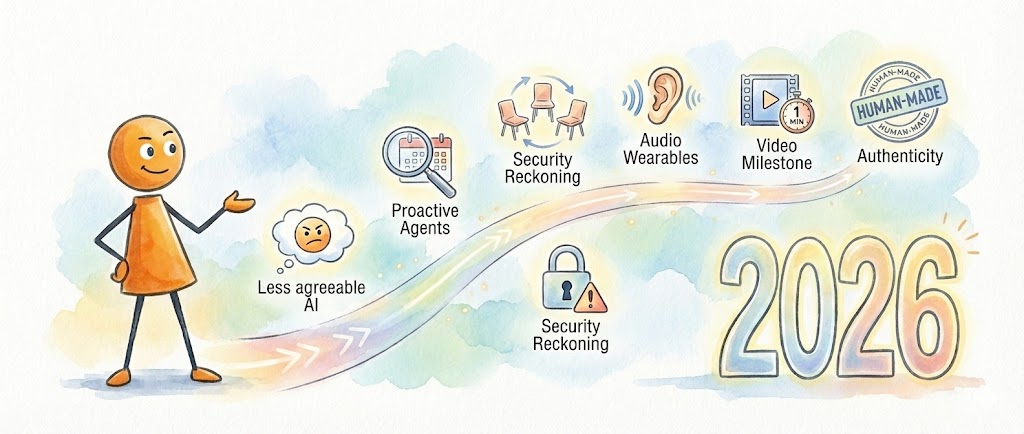
AI in 2026: Another fast moving transition year
What's next for AI in 2026? Dive into my predictions on agentic AI, the battle for audio wearables, the 1-minute video milestone, and the authenticity race.
Read more
The future of innovation, startups and the world. That's all.
I'll reflect on both in the next week or so I suspect but this week's newsletter looks at innovation, the business of looking into the future, how.
Read moreStrawberry picking robots, winning users and societal challenges.
This week returns to strawberry picking robots, overcoming inertia to win users and the challenges of user generated content for children and wider.
Read more